Falconrace.cz
• Connecting • Protecting • Educating
Member of the International Federation for Falconry Sports and Racing
First international falconry race of this kind in the Czech republic
20-21/09/2025, Podhorany airfield >>
General public invited!
About the race
The falconers all over the world are naturally competitive and proud of their ‘little athletes‘. One of the possibility to attend a competition where the falconer can compare the fastness of falcons is the ‘Telwah race‘. Such race has became common in the Arabic countries like the United Arab Emirates („The President Cup“), the Saudi Arabia („King Abdulaziz Falconry Festival in Riyadh“) and the Qatar („Al Da’aw Championship at Marmi“). Telwah falconry has been followed by English falconers in Vowley where the racing on lure and robotic quarry has been held since 2019.

Falconry is a specific ancient method of hunting using birds of prey as copartners. In the Czech Republic, the phenomenon of Falconry is established under the protection of organisation called „Českomoravská myslivecká jednota“, and involved in its „Club of falconers“ with more over than 500 members. The falconers are usually not only hunters with falcons or hawks, they are game keepers as well. The popularity of Falconry is worldwide. Finally, Falconry is conserved as intangible and living cultural heritage by UNESCO.
The Falconry does not express only ‘hunting‘ but means several preliminary steps which include proper training. The beauty of birds of prey might be revealed during variety of training methods as well. The speed and manoeuvreability is impressive! You are the coach and the bird represents your athlete!
The original method of training the falcons used for ages is the lure. The fast and shifty flight is an elementary premise for successful hunt.
The falconers all over the world are naturally competitive and proud of their ‘little athletes‘. One of the possibility to attend a competition where the falconer can compare the fastness of falcons is the ‘Telwah race‘. Such race has became common in the Arabic countries like the United Arab Emirates („The President Cup“), the Saudi Arabia („King Abdulaziz Falconry Festival in Riyadh“) and the Qatar („Al Da’aw Championship at Marmi“). Telwah falconry has been followed by English falconers in Vowley where the racing on lure and robotic quarry has been held since 2019.
In our vision, we would like to introduce similar falconry racing in the Czech Republic according to our Arab and British colleagues. Such racing would be defined on the basis of same rules like in the countries of the origine of this sport. There will be the flat race on 400 meters for falcons and moreover the flat race on 100 meters for Harris’s Hawks using the lure machine. This kind of race would be the first one ever for Harris’s Hawks, with newly defined rules. Such racing extension would be appreciated by the falconers, both before and after the hunting season.
Time remaining until the third year of the race
Day(s)
:
Hour(s)
:
Minute(s)
:
Second(s)
Information for race participants
You can follow all the latest news on our Facebook page!
Registration
Registration for the 3rd year of this race will be open on 01/08/2025.
The registration fee is 45 euros for each racing bird of prey.
Registration from 01/08/2025
Race rules
The rules of the race are twofold – general, valid for all birds of prey, and specific for individual groups.
Important information on registration and race programme
- Registration for this race took took place between 10/08/2024 and 10/09/2024.
- The account number for payment of registration fees is 2669879028/ 3030, IBAN: CZ2130300000002669879028, BIC: AIRACZPP (download payment details in PDF). The registration fee is 45 euros for each bird of prey entered in the race. Please pay the total amount to the above account within 48 hours of submitting the registration form. When paying online, please include your surname and phone number with international dialling code (e.g. 00420 777 111 222 333) in the note.
- After registration, participation will be confirmed by email.
- In case of ‘CITES-species’, the CITES documents will be demanded at the reception.
- The race will be held for two days until 29/09/2024.
- The beauty contest will be held only on the first day, i.e. on 28/09/2024. Each participant will choose one favourite from all his/her registered falcon birds of prey to take part in the competition for the most beautiful bird of prey.
- Download links to accommodation in the area of the race (PDF).
- NEW!
The competitions are followed by falconry hunts FALCONRACE HUNTING DAYS from 30/09 to 3/10/2024 with the possibility of fee hunting of wild pheasants and hares:
– hunting of wild pheasants only from waiting on will take place on 30/9/2024 and 1/10/2024 in hunting grounds in South Moravia.
– hare hunting will take place mainly in hunting grounds near Brno from 30/9 to 3/10/2024. A falconer competing with a falcon may also take part in hunting hare game with a shortwings, except eagles.
In both cases, fee hunts are only offered to the first ten registered competitors per hunting day who have also paid the registration fee for the race within 72 hours of submitting the registration form. The hunting fee of 45 euros per day will be paid on the spot. The registration form will allow the participant to indicate which hunt day they are interested in. Registration results for hunting days will be announced in due time!
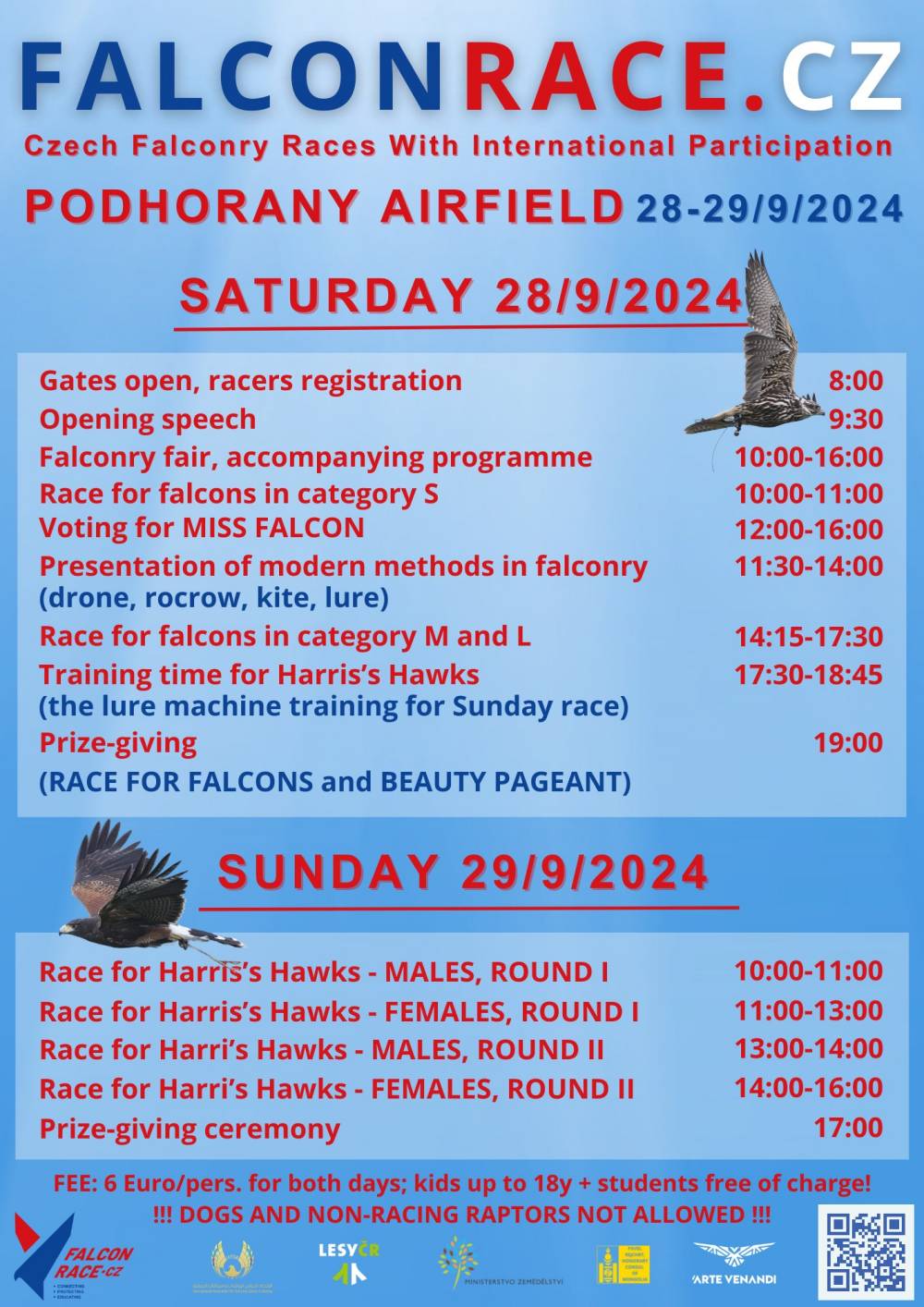
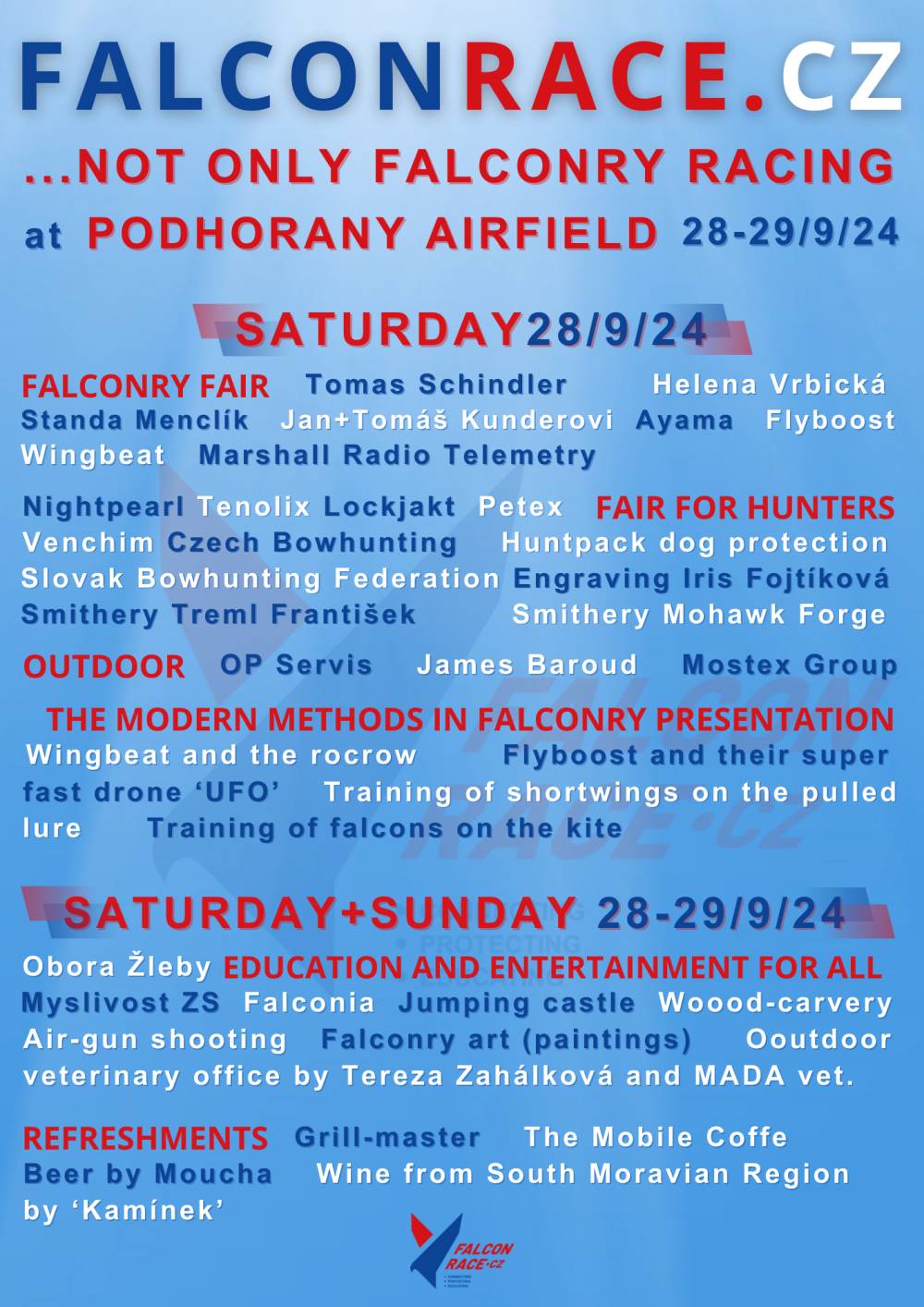
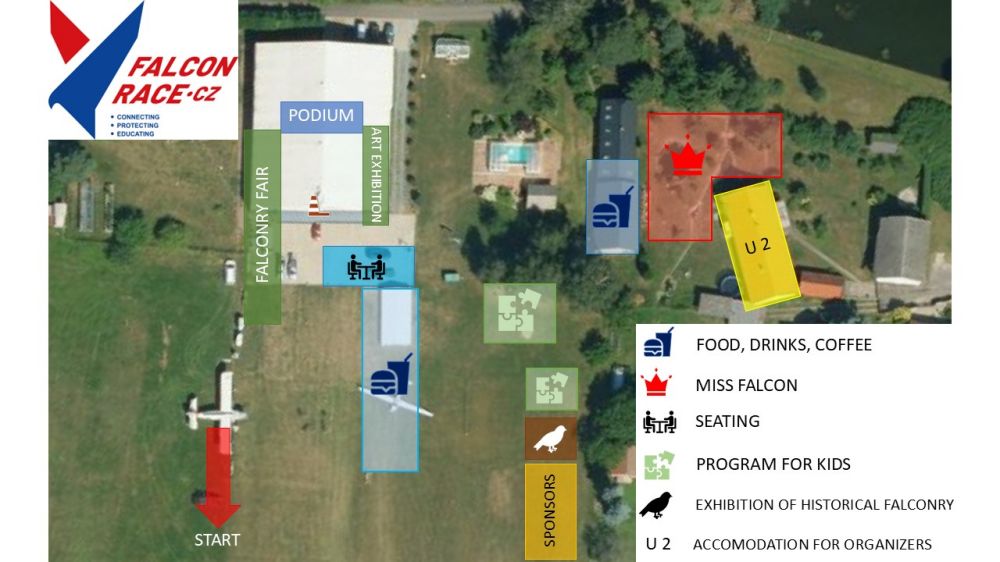
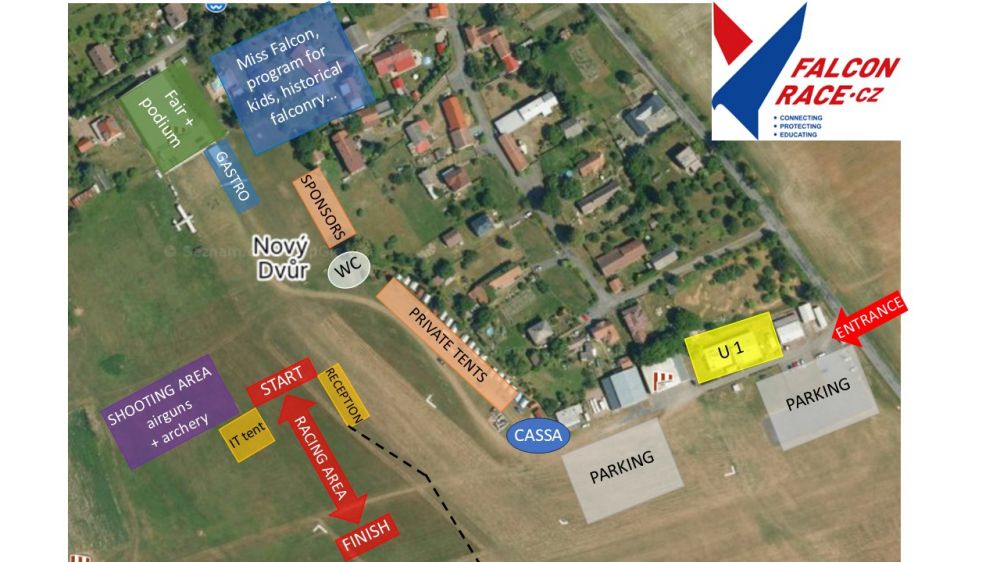
Programme of the second year´s event
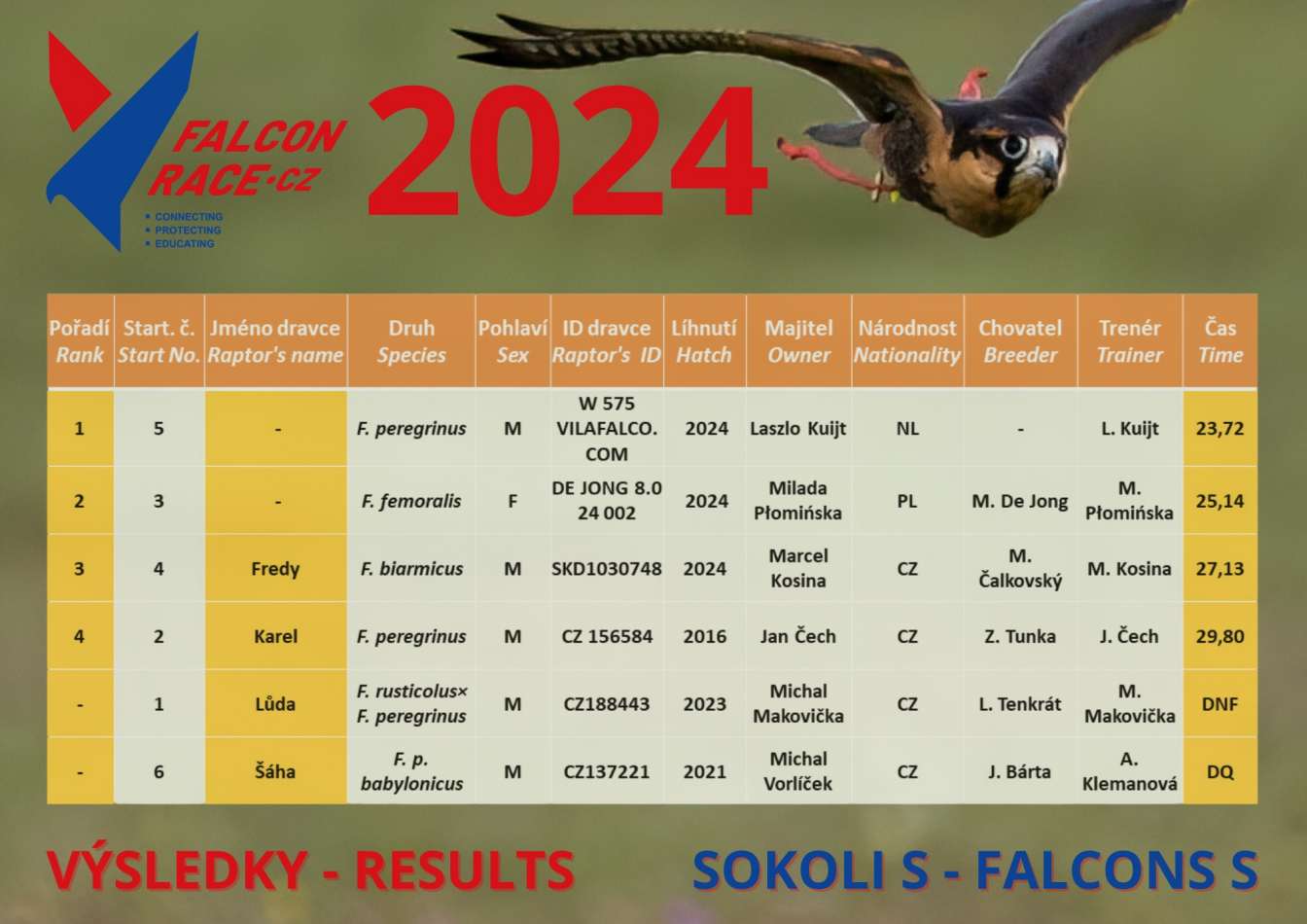
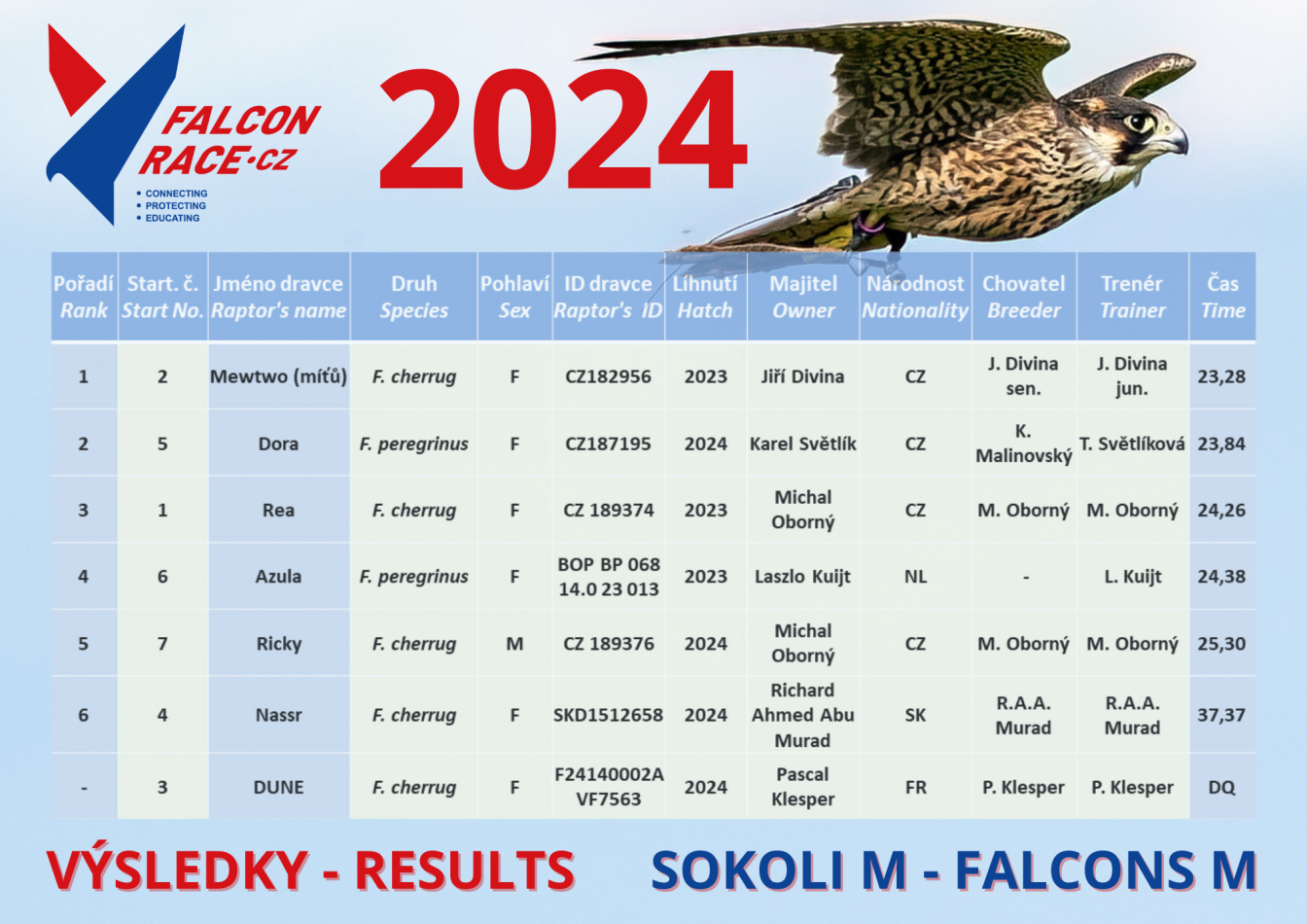
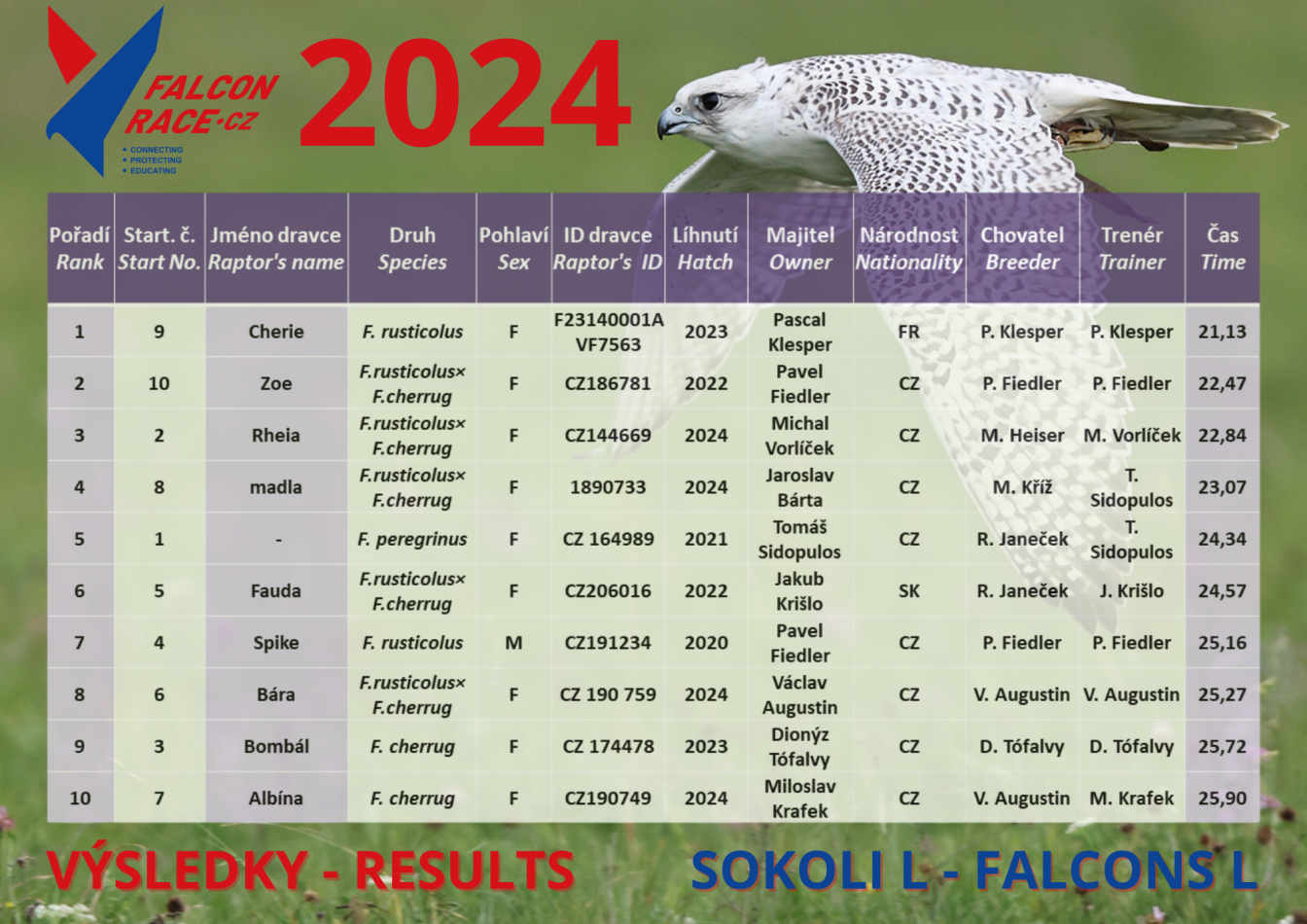
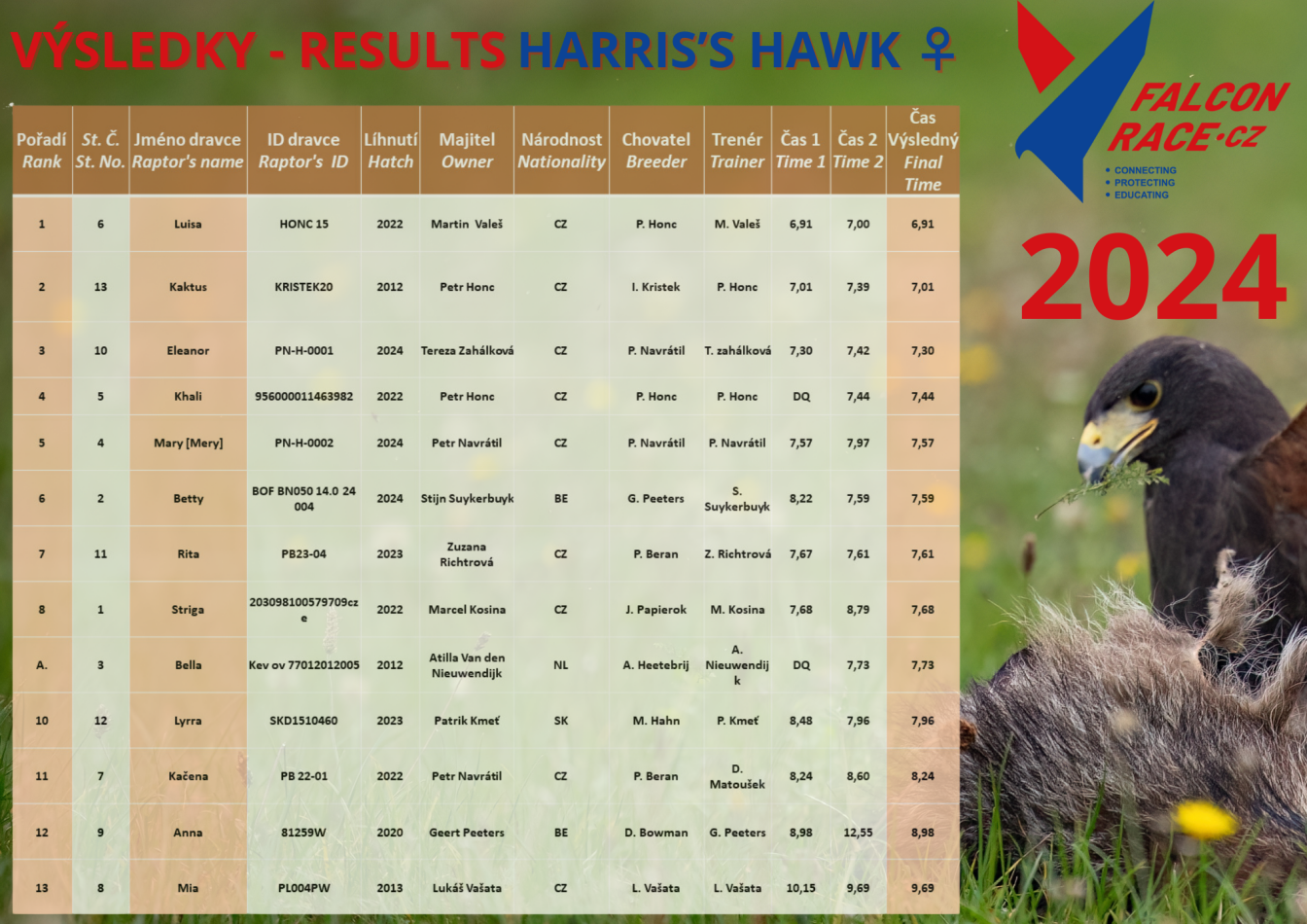
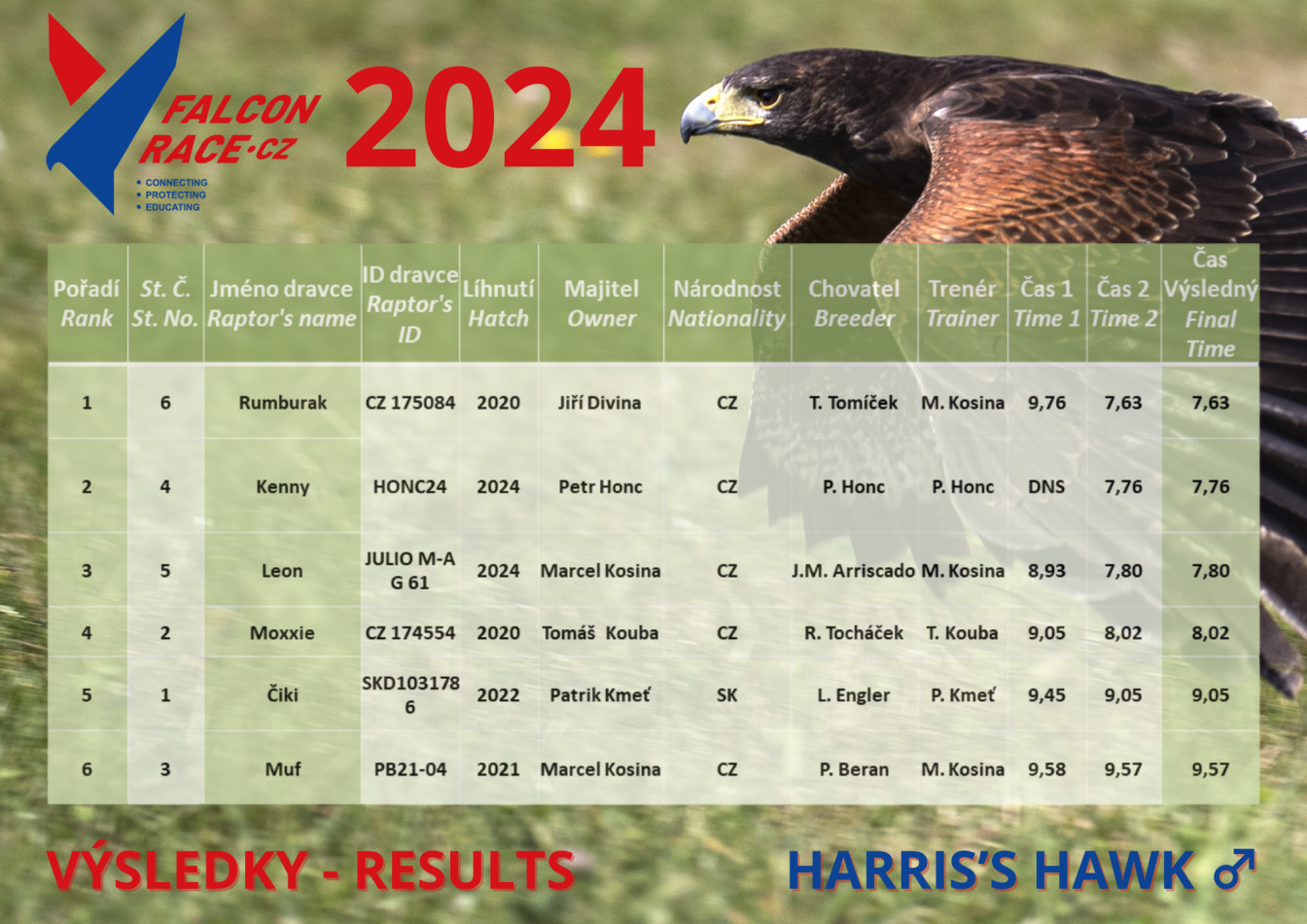
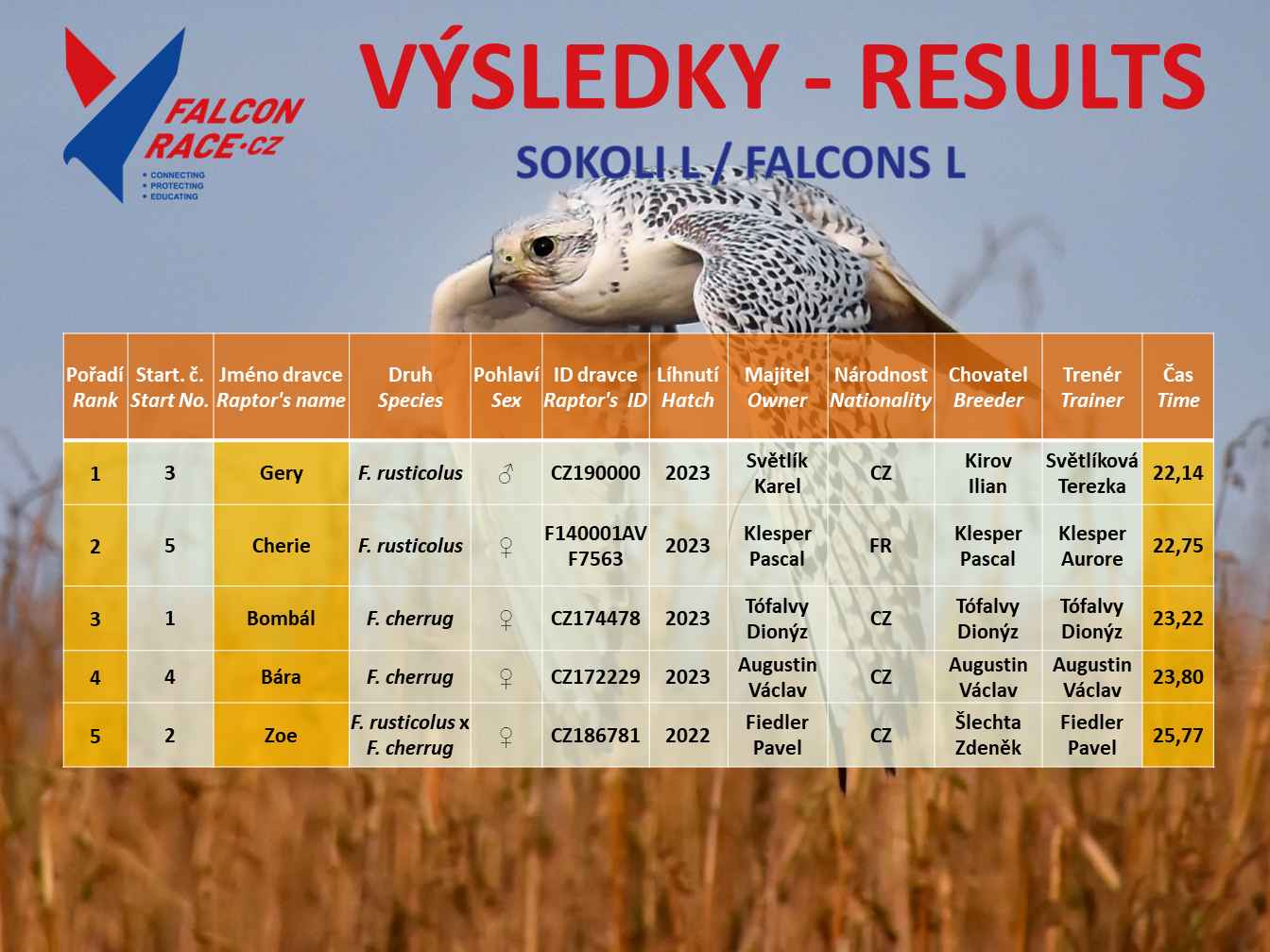
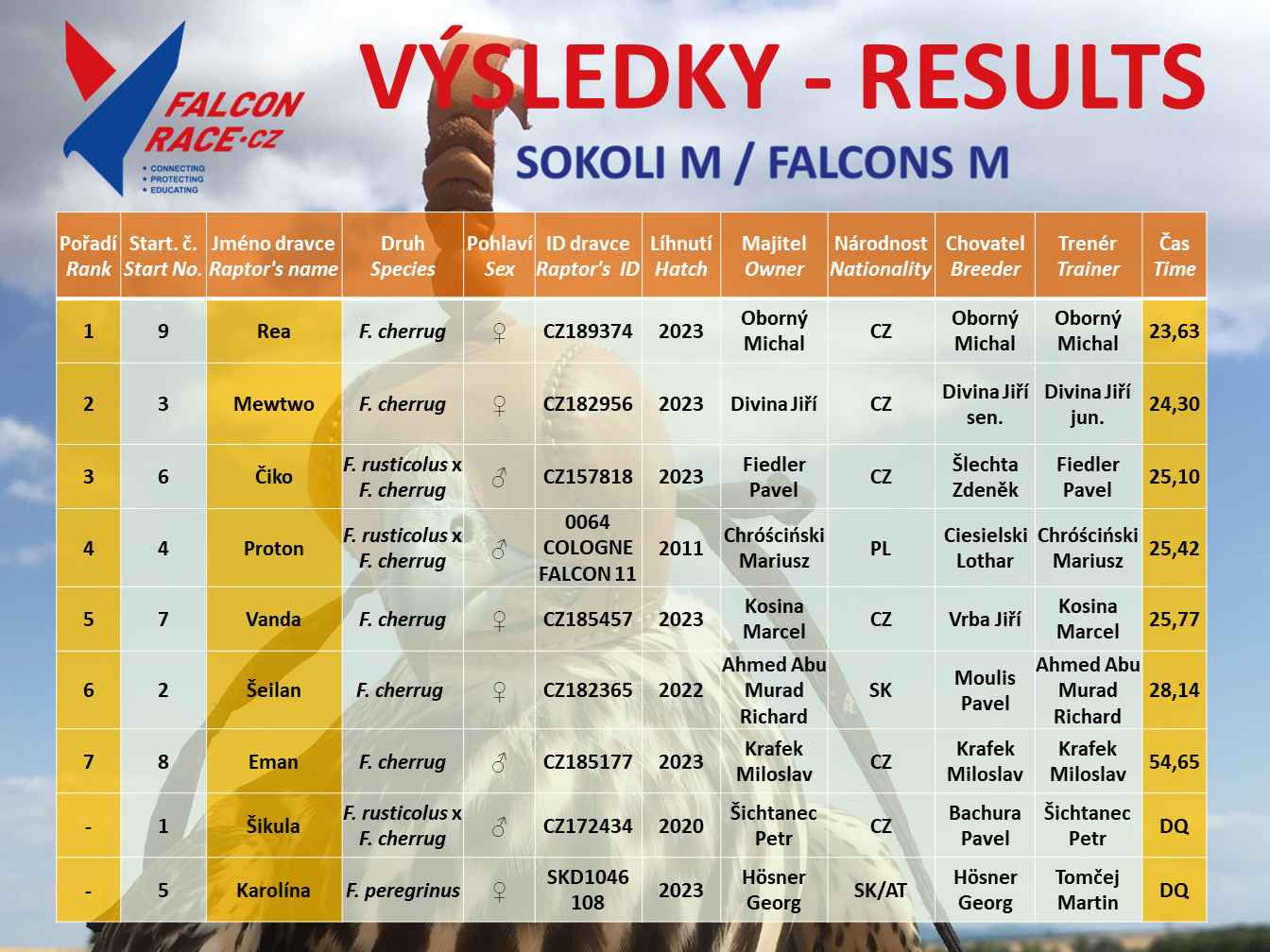
Results of the second year of the race
Congratulations to the winners!
Archive of results
First year 2023
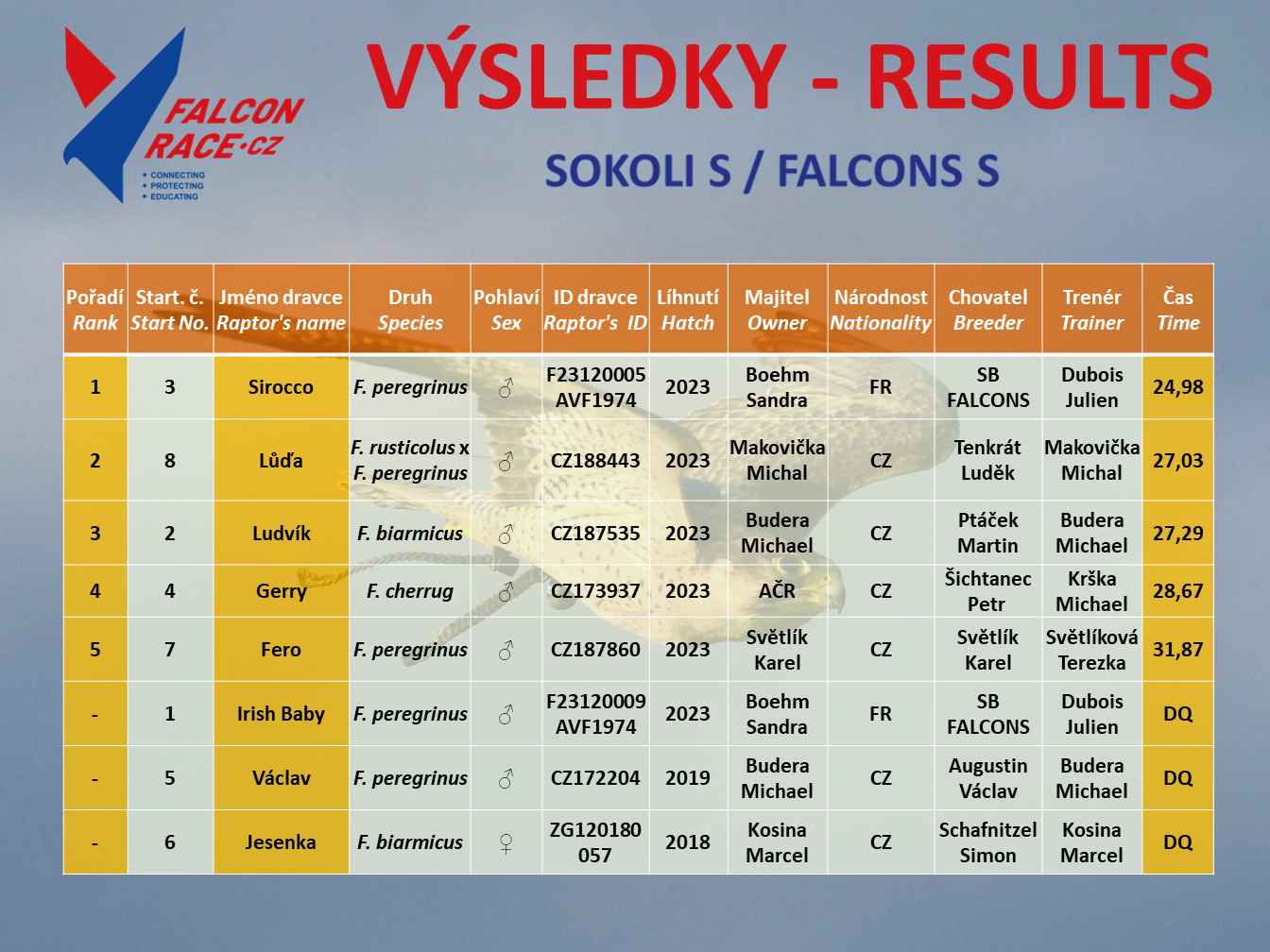
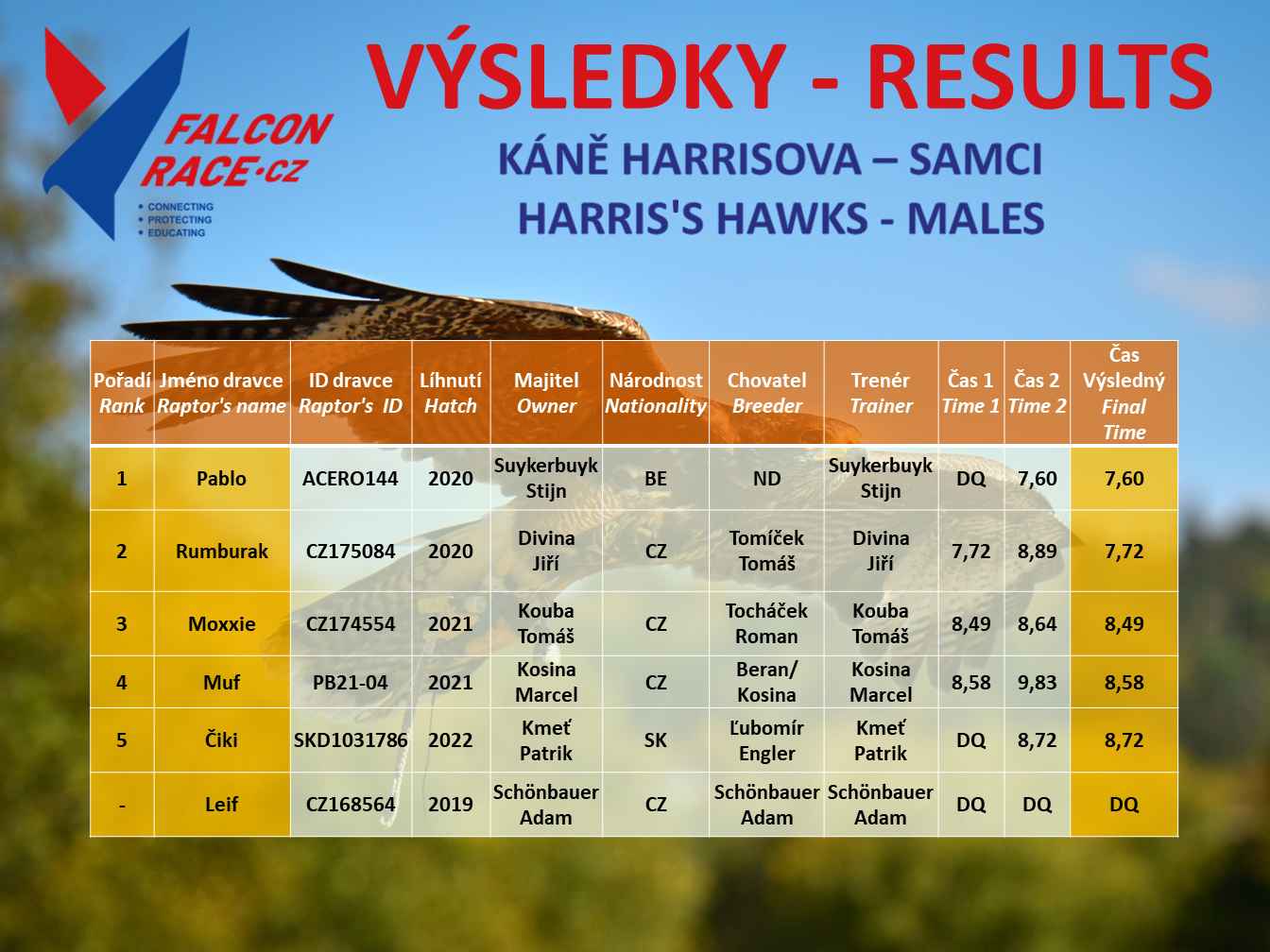
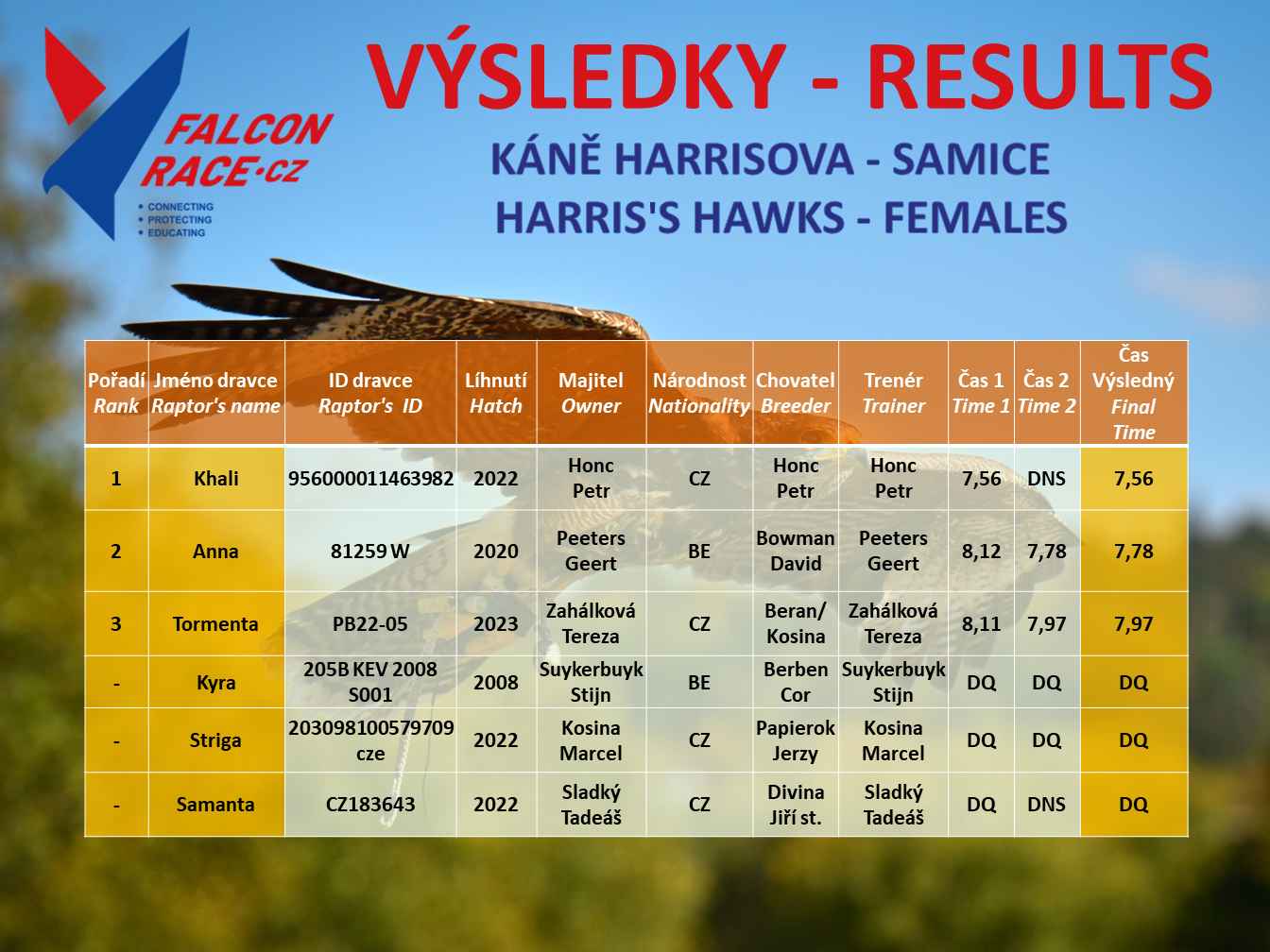
FALCONRACE.CZ 2024 was held under the aegis of the Minister of Agriculture Marek Výborný.
As of 25.7.2024 we are members of the International Federation of Falconry Sports and Racing (IFFSR) >>
Race categories
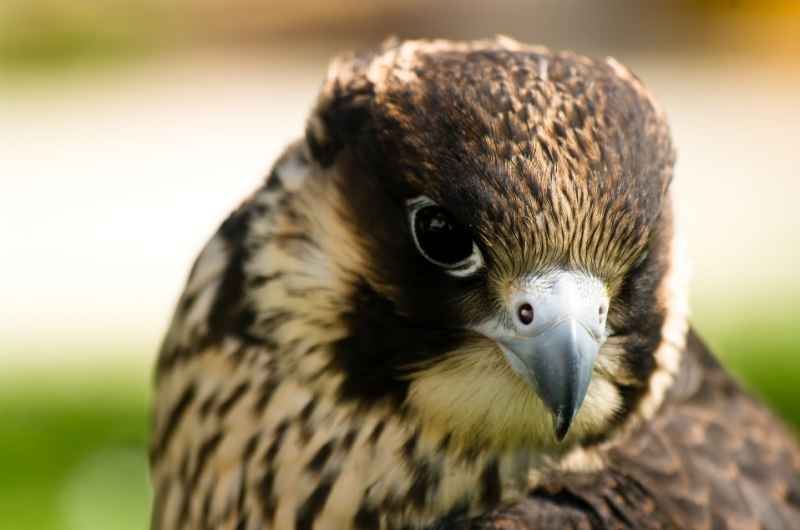
Falcons
Flat race on 400 meters in 3 weight categories.
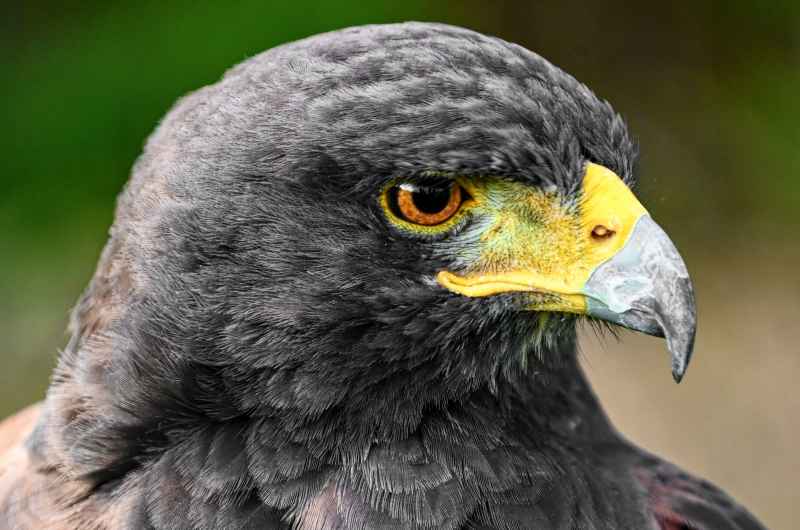
Harris’s Hawks
Flat race on 100 meters using the lure machine in 2 categories.
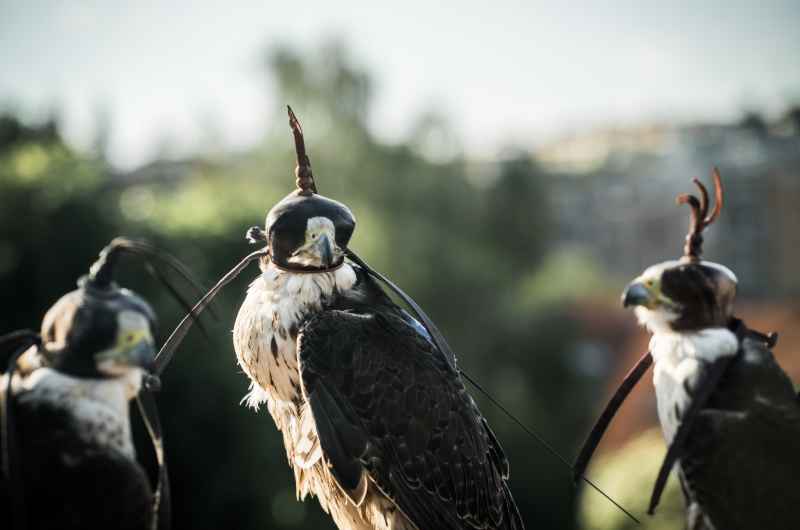
Beauty pageant
Voting by the public and competition participants for the most beautiful registered falcon.
Falcons category
The falcons category competes in speed flat race on 400 meters. These raptors will be divided into three subcategories according to their weight:
→ S (small): 200 to 700 grams
* Aplomado falcon ♂
* Aplomado falcon ♀
* Peregrine falcon ♂
* Saker falcon ♂
* Lanner falcon ♂
* Lanner falcon ♀
* Shaheen falcon ♂
* other small falcons and their hybrids
→ M (medium): 700 to 1000 grams
* Peregrine falcon ♀
* Saker falcon ♂
* Saker falcon ♀
* Lanner falcon ♀
* Gyr falcon ♂
* other medium falcons and their hybrids
→ L (large): above 1000 g
* Peregrine falcon ♀
* Saker falcon ♀
* Gyr falcon ♂
* Gyr falcon ♀
* large falcons hybrids
Category of Harris’s Hawks
This category is smaller in number. Hawks are chasing a lure in the flat race on 100 meters. This category is divided to:
→ males
→ females
Category of the most popular falcon
The birds will be exposed to the public all at one place on the perches for some time. The public and competition participants can vote for the most popular falcon. The results will be announced at the end of the event together with the results of the race. This competition is dedicated only to falcons. Unfortunately, Harris’s Hawks are very similar to each other and thus hard to differentiate by the non-falconry visitors.
Rules of the race
General rules of the race
1) The Trainer is the person acting individually of leading a team of people who have trained one or more falcons together throughout the training period.
2) The Team is the Trainer and a support crew who have trained one or more falcons together for a race on behalf of one or more Owners.
3) A Team cannot include two independent Trainers.
4) In the Flat Race the Falconer is the Team member luring and retrieving the falcon. The Falconer is also the person who is unhooding and releasing the falcon.
5) The Owner is the Owner of the falcon at the start of the race.
6) An Owner can own more than one falcon and a falcon can have multiple owners.
7) The Owner of the falcon is the only one who wins the prizes.
8) The Breeder is the person or stud that hatched the falcon.
9) The Organisers shall not be responsible for any injury or loss to any falcon, howsoever caused.
10) The bird of prey must have a means of attaching a transmitter supplied by the team or race management.
11)The falcon must carry a non-removable official registered ring or microchip identifying it as the individual described in its legal papers.
12) The order of flying will be drawn from a hat by the organising team. Wherever possible no two falcons from one team will be flown consecutively.
13) If the weather changes during the course of the competition, no allowance will be made to any competitor except that the Timekeeper may decide to temporarily halt the competition or cancel it altogether because conditions are unsafe, for example low fog, storm of heavy rain.
14) The wind strength must not exceed 10,7 m/s and the temperature must not exceed 28°C.
15) The winner is the falcon with the lowest time score.
16) The timekeepers must declare their impartiality and that they have no interest in any of the competitors.
17) If the falcon wanders off, the organising team will decide whether or not to fly the next falcon.
18) If a lost falcon is still not recovered, the falconer responsible for the next falcon has the right to refuse to fly because of risk to his own falcon. In this case his falcon will be moved to the last position in the flying order.
Download general rules in PDF.
Rules for falcons
1) The race distance is normally 400 m along a smooth, level track.
2) The start and finish gate is formed using two suitable coloured pillars. The falcon must flight above both the start and the finish line between the pillars.
3) One of the measuring devices will be a radio-controlled stopwatch, controlled by several timekeepers. The mean value of the measured times on this device will be calculated as the final value.
4) The start line, defined by pillars, is 6 m long and the falconer is standing on the specified post in the distance of 6 m in front of the line.
5) The finish line, defined by pillars, is 30 m long and the falcon must go through the gate to complete the race.
6) In case of additional main or backup measuring devices added, the dimensions and location of the start and finish line may be adjusted on site, but always to ensure measurement at the declared distance of 400 m.
7) The Falconer can call the falcon using only the lure (Telwah) and audible calls, and must stand behind the finish gate. The Falconer can move whilst using the lure. The meat for the falcon might be fastened on the lure.
8) The dress of the Falconer can be any type and might have reflective colours.
9) On unhooding the falcon, the Falconer must keep his hand static. Any attempts to launch the falcon from the hand will disqualify the entry.
10) A falcon which fails to start after two minutes from being unhooded will be disqualified.
11) If a falcon fails to complete the course within three minutes from unhooding, then it will be disqualified.
Download falcon rules in PDF.
Rules for Harris’s Hawks
1) The length of the racetrack for both sexes is 100 meters on the smooth trimmed surface (grass), suitable for the run of the lure-machine.
2) The hawk can compete in both the first and second rounds, with the better result counting.
3) The speed of flight (time) is measured between two gates (start and finish). The gates are pillars suitable coloured. The start gate is 6 m wide and the finish gate is 20 m wide. The time measuring will be done by operators using stopwatches (manually and radio-based operated). The middle value will be considered. Moreover by the start-gate an announcer will signalize the leaving of hawk from the glove for the operators with manually operated stopwatches.
4) The lure will start its path from the suitable cover made of natural material (grass, bush, or alterntively a camouflage mesh) in the distance of 20 meters from the starting gate/line.
5) The lure escapes the bird in that manner to motivate it maximally. The speed of the lure could vary. The lure can even stop.
6) The falconer can use their own lure of maximum total weight of 500 gram with the loop for easy removal of the lure from the rope. The falconer is immediately leaving the racing area for the tent at side for feeding the hawk.
7) The meat is fastened on the lure by the falconer. Falconer can ask the organising team for the meat without complaining about its quality.
8) The falconer standing at the starting gate announces loudly that he/she is prepared („prepared“) to release the bird.
9) The falconer’s hand with a glove must be static. Calming the predator before releasing is allowed. but any attempt to release (throw) the bird by force leads to disqualification of the racing bird. After the announcement, the falconer waits for the lure running from cover whilst releasing the bird.
10) The bird that will not leave the falconer’s glove in 10 second will be disqualified.¨
11) The bird may leave the glove in an opposite way than the lure is running or sit for a while, but must finish the race in 60 seconds from leaving the glove.
12) The racing team can bring their own lure machine or choose one of the offered ones by the organising team. The lure machine might be electronical or mechanical.
13) The lure machine might be operated either by the falconer releasing the hawk or by another person from the racing team. The organising team can offer help with operating the machine. In that case no complains are taking into account if the hawk catches the lure before the finish line.
14) The lure machine can be situated in the middle of the race-path or at the START according to the lure type and choice of the falconner.
15) The lure runs from the cover which is up to 20 m far from the START line according to the choice of the falconner.
16) The hawk cannot catch the lure before the FINISH line!!!
17) A new start is enabled only in case of mechanical failure of the lure machine or its components.
Download Harris’s Hawks rules in PDF.
and more followers on social networks
registered birds of prey in the 2nd year of the race
home countries of participating falconers
Thank you to our partners and sponsors











































Contact us
FALCONRACE.CZ, z.s. (registered association)
Černá u Bohdanče 81, 533 41 Černá u Bohdanče
IN: 21400342
Data box: vvm9br7
under the aegis of Artevenandi.cz – pigeon prevention and trapping.
